Wayfaring
We are all sojourners, all on our own journeys, all wayfarers in one way or another.

Once a journey is designed, equipped, and put in process; a new factor enters and takes over. A trip, a safari, an exploration, is an entity, different from all other journeys. It has personality, temperament, individuality, uniqueness. A journey is a person in itself; no two are alike. And all plans, safeguards, policing, and coercion are fruitless. We find after years of struggle that we do not take a trip; a trip takes us.
~John Steinbeck, Travels with Charley: In Search of America, p. 1
This essay is adapted from an earlier reflection shared at the Waypoint Contemplative Service at the Cathedral of the Rockies here in Boise, on 6-10-26. You can see a video recording of the original here.
By the grace of God I am a Christian, by my deeds a great sinner, and by my calling a homeless wanderer of humblest origin, roaming from place to place. My possessions consist of a knapsack with dry crusts of bread on my back and in my bosom the Holy Bible. That is all!
~Unknown
Thus begins The Way of a Pilgrim, written of uncertain origin, found in Mount Athos, first published in 1884. It is a story of a peasant, wandering through Russia, seeking the answer to the question, “How does one pray without ceasing.”
The moon and the sun are eternal travelers. Even the years wander on. A lifetime adrift in a boat or in old age leading a tired horse into the years, every day is a journey, and the journey itself is home.
~Matsuo Bashō
And so began the classic travel haibun, Narrow Road to the Interior, written nearly two centuries earlier by the master haiku writer, Matsuo Bashō, first published, posthumously, in 1702.
Different centuries. Different countries. Different religions. Different reasons. Different types of pilgrimage. Same spirit.
Bashō goes on to say “From the earliest times there have been some who perished along the road. Still I have always been drawn by windblown clouds into dreams of a lifetime of wandering.
We are all sojourners, all on our own journeys, all wayfarers in one way or another. Some of us have been pushed, some of us have been pulled, but we are all on a trail, we all take detours, and we all take step after step over our lifetimes.
We’re all just slouching or easin’ or truckin’ or rambling down the road.
Some of us know exactly where we’re headed. Some not so much.
And we all need waypoints, places of rest, along the way.
Sojourners All
Welcome, fellow sojourners. Thank you for joining me on this stretch of the path today.
Whether you come feeling rested or weary, hopeful or uncertain, I am glad you are here. We are all people on a journey. We are all travelers through life.
A sojourner is someone who has not fully arrived. Someone who is still learning, still searching, still becoming.
Recently I was on a hike on the Dry Creek trail here in Boise and picked up stones for folks coming to our Waypoint service. This is the one I chose for me.
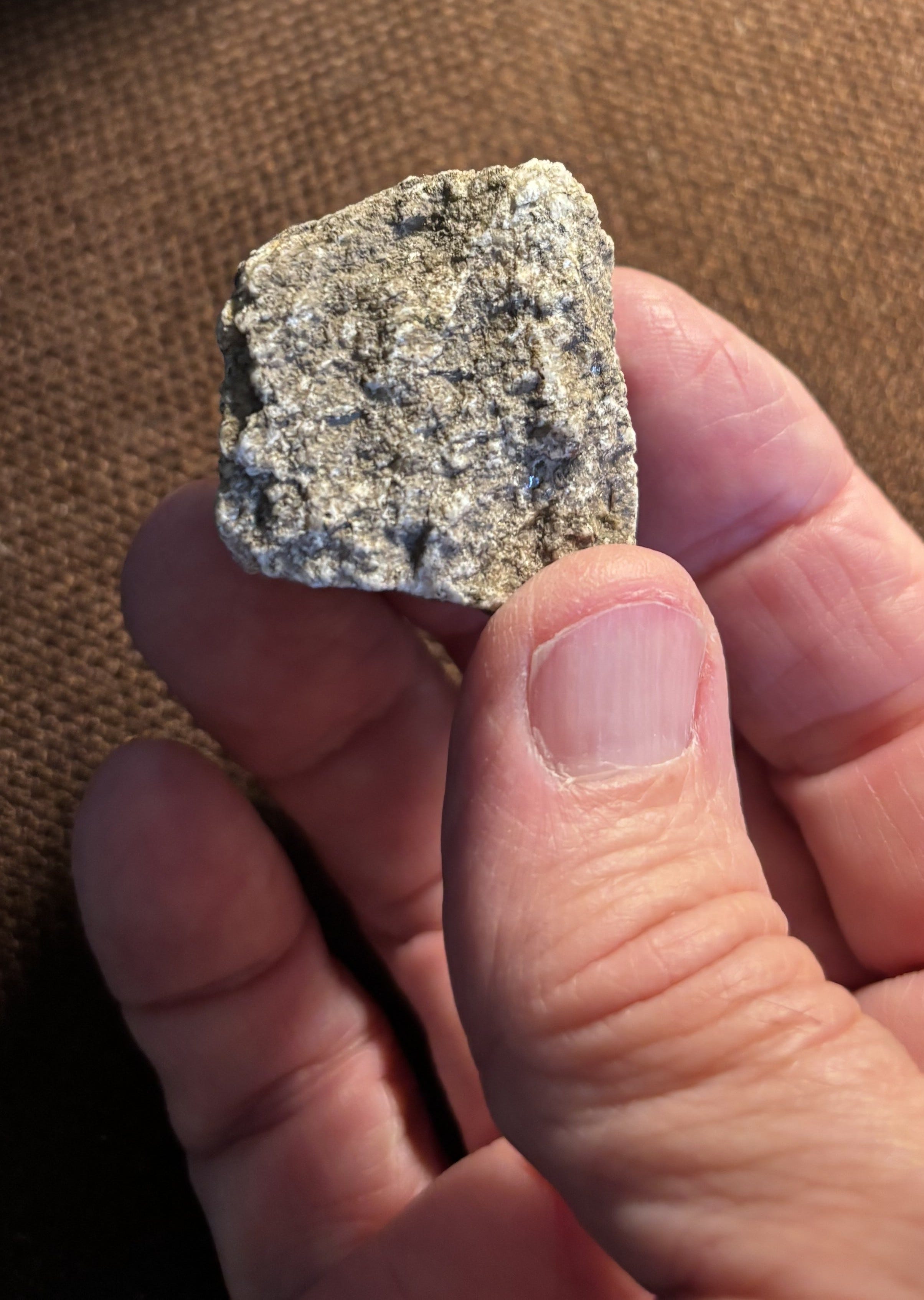
It is simple. Ordinary. Weathered. It ain’t prettied up. It’s been walked on.
Like us.
A stone bears the marks of the journey it has traveled. It has been shaped not by avoiding the rough and tumble, but by staying the course. It’s a stepping stone for others and the makings of the path upon which they tread.
Like us.
Along the Camino de Santiago, pilgrims often carry a stone for many miles. The stone may represent a burden, a prayer, a grief, or a hope. At a place called Cruz de Ferro—the Iron Cross—many pilgrims leave their stones behind. Dropping off their prayers, their hopes, their regrets in the hands of something beyond them, for safekeeping, for support.
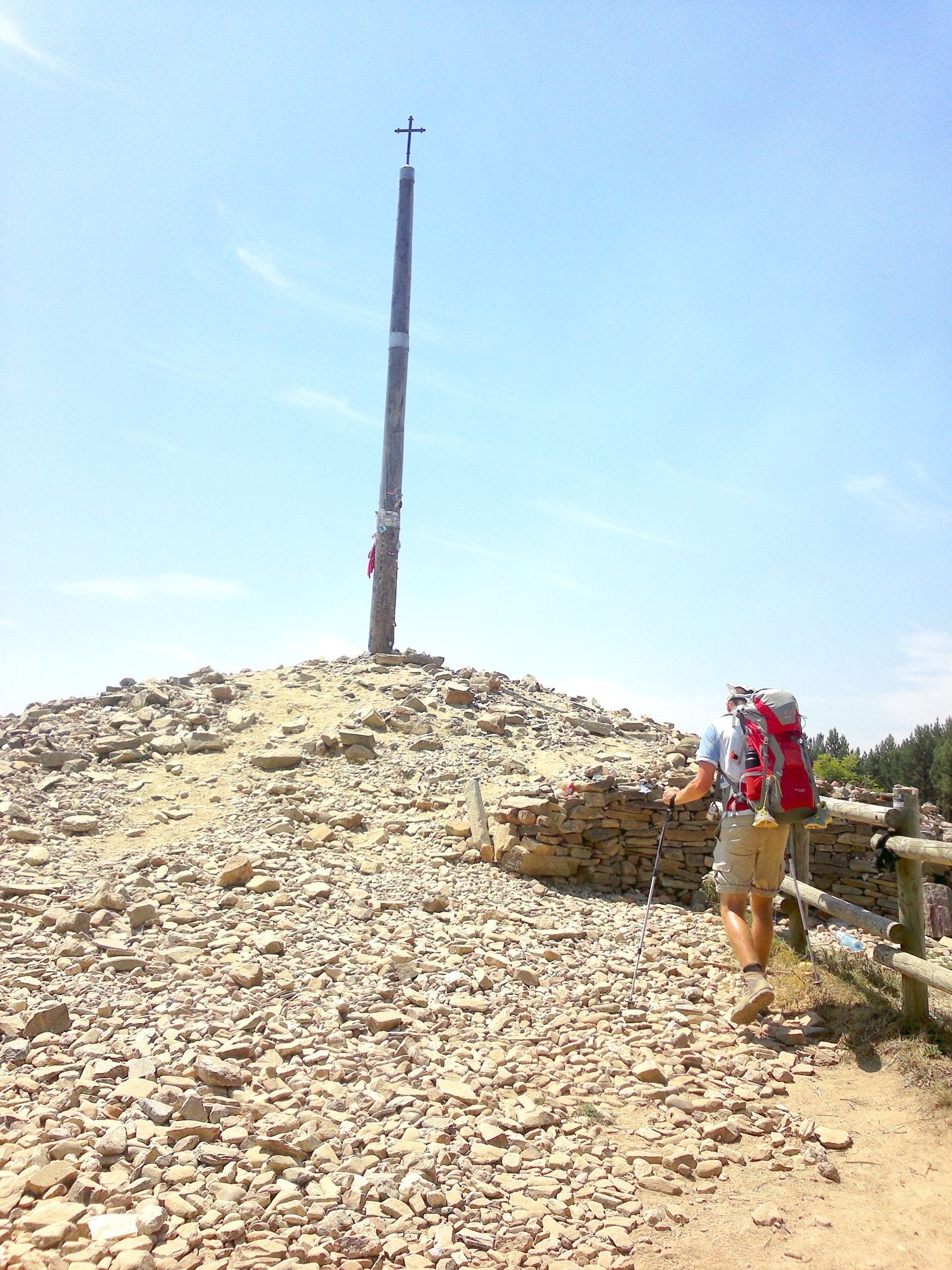
Credit: Random username 083794703875938, CC0, via Wikimedia Commons
Cruz de Ferro - Iron Cross
I’ll be taking this stone with me on to the next leg of the Camino. My son Shane and I have been walking The Way these last four years - this will be our fifth leg of the journey. And I will be leaving this stone at the Cruz de Ferro on our second day.
Wayfaring is Life Itself
The Camino is one form of wayfaring.
Life itself is another.
The road of life - cobblestones or mud, freeways or toll stations, detours or permanent train tracks - shapes our journey, doesn’t it?
I invite you to do something symbolic yourself. It doesn’t have to be a stone, it doesn’t have to be anything, but it could be. It could be a piece of pottery, or prayer beads, or a feather. It just needs to be something that will help you take inner swirling thoughts or assertions or plans or prayers and make them more visible, solid, and real. Yes, it’s symbolic, but in symbolism we can evoke deep understanding and mindful anchors to what’s important to us.
It will be something you can touch.
And therefore, something that can touch you.
Keep it with you or put it someplace special in your home. Or leave somewhere for safekeeping, or support.
Wanderers
Throughout history there have been people who embraced the life of the wanderer.
Some, like the Russian peasant, wander from place to place seeking answers or adventure or peace. Some, like the poet Bashō, walk attentively, observing, fully experiencing each step. Some, like pilgrims on the Camino de Santiago, chose one of a number of established paths. Wandering does not necessarily mean arriving somewhere, but it’s almost always about becoming.
There is a difference between a pilgrim and a wanderer, but they are also close cousins.
Pilgrims often have maps. They know where they are going. Wanderers often do not. The wanderer discovers the path by walking it.
Yet the two are not opposites. In fact, many pilgrims become wanderers, and many wanderers discover they have been pilgrims all along.
The pilgrim in The Way of a Pilgrim is both. He travels without a fixed route, yet he is moving toward something sacred.
Whether we call ourselves pilgrims, wanderers, or sojourners, we are all being shaped by the journey.
And all travelers need places to stop and rest.
Waypoints
Which brings me to the idea of a waypoint.
No one can wayfare continuously. Bashō stopped along the way. Pilgrims stop at monasteries and auberges. The Pony Express had relay stations and home stations. Hikers like me just haveta stop and sit on a rock here and there. Ultrarunners stop at aid stations. There are oases, wellsprings, safe harbors, waystations. Every wayfarer needs stopping points along the way.
On long races, say 100 miles, aid stations are set up for runners to eat or drink or change bandaids or clothes. Often runners have their own support crews who help pace them or make sure they eat or drink what’s needed during such a long endurance run over multiple terrains and weather conditions. Over 24 or 48 or more hours.
A waypoint is not a destination. You are not meant to live at a waypoint.
It is a stopping place along the way. The best waypoints offer hospitality, companionship, renewal, and perspective. They remind us who we are before sending us back onto the road. It gives us a chance to catch our breath and to prepare for the next leg of the journey.
Every pilgrim needs to take a load off at a soul aid station along the way. That’s what our contemplative services are for. That’s what a walk in the Boise foothills does. That’s what a summer concert or a family picnic or a trip to a museum can provide. These soul aid stations - forgive the endless metaphors - are also EV chargers. Battery plug ins.
On this lifelong journey of ours there will be side trips, and many of those will be where the fruit is hanging. Some will be unintended consequences. Others will lead to unfordable rivers, and we’ll have to find a way around. Those will be times when we’ll especially need waystations, where we can regroup. Rest. Message our spirit. Reconnect to our most profound, deepest, joy-producing self.
What waypoints have sustained you on your journey? Why were they?
A place, a person, a practice, a community, a prayer, a book, a trail, a song—what has helped you rest, reorient, and continue on your way?
What kind of wayfarer are you? Which one feels most joyous for you?
Do you travel with a map, like a pilgrim? Or do you discover the path by walking it? Or perhaps a little of both?
As we continue developing this book in public, I’d love to hear your thoughts.
Does the metaphor of life as wayfaring resonate with you? Why or why not?
What does it illuminate about your own experience? And what, if anything, might it miss?
Your reflections will help shape future essays—and perhaps even the book itself.
We are wayfarers. We are never done, we are always becoming. We are not and will never be perfect, but we can intentionally keep getting better along the trail. We don’t have to be finished, and certainly not a finished product for goodness’ sake.
We are still learning. We are still walking. We are wayfarers.
As Bashō wrote:
“Every day is a journey, and the journey itself is home.
We are still learning. We are still walking. We are wayfarers.
We find after years of struggle that we do not take a trip; a trip takes us.
~John Steinbeck, Travels with Charley: In Search of America, p. 1
I relate to Basho's comment: "Still I have always been drawn by windblown clouds into dreams of a lifetime of wandering."
And sometimes, the most difficult journey is one in which you just sit down and receive what's arising. No phone; no TV, no conversation. Just openness to what is. Sounds. Smells. Thoughts. Etc.
Basho understood this too.